Functional MVP / Project Detail
Itinerary Orchestration & Cost Modeling Platform
A functional travel-planning MVP for exploring Pakistan, generating personalized itineraries, estimating regional costs, reserving package seats, and managing travel operations.
Template
Project Snapshot
Every project page follows the same template so systems can be compared by classification, stack, scope, workflow, engineering signals, and outcome.
Functional MVP / Full-stack travel planning platform
System Context
The context section explains what the system is, why it exists, and what was achieved.
Problem Statement
Travel planning information for Pakistan is fragmented across destination websites and manual booking channels. The platform needed to unite research, itinerary creation, cost estimation, package discovery, and registration in one coherent experience.
- Destination discovery, personalized multi-day itineraries, regional multi-currency pricing, package reservations, custom-trip registrations, and authenticated travel operations.
- Delivered a functional full-stack MVP that combines Pakistan destination discovery, shareable itinerary generation, multi-currency cost modeling, package reservations, custom-trip intake, and authenticated operational management.
Features
Functional Scope
The project scope is framed around real product and operations behavior rather than a surface-level screen list.
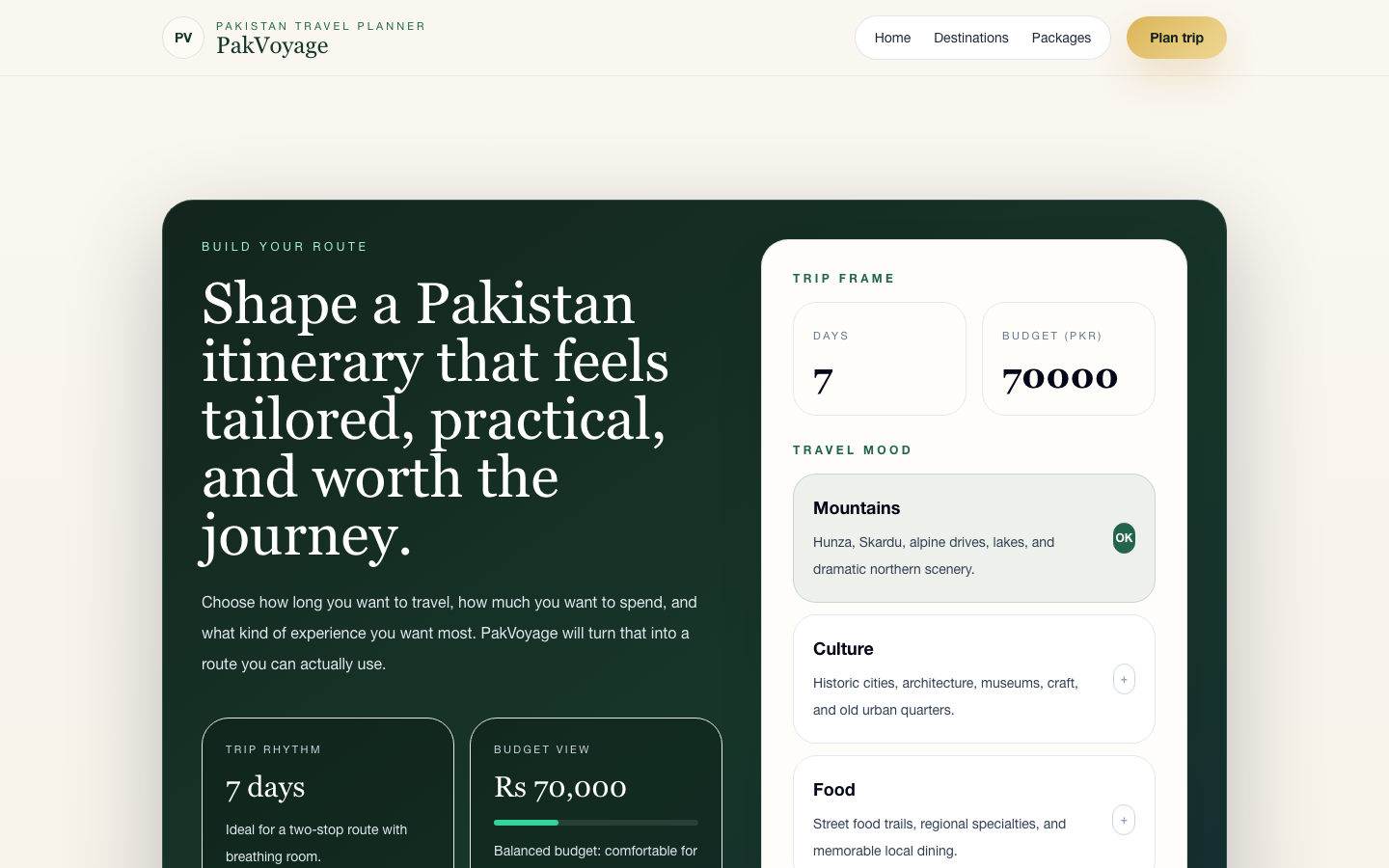
Personalized itinerary generation based on budget, trip duration, and interests such as mountains, culture, and food
Day-by-day destinations, activities, travel guidance, and itemized cost breakdowns
Regional pricing for local, Chinese, and international travelers across PKR, USD, CNY, GBP, AED, SAR, and EUR
Database-backed, shareable itineraries with persistent pricing and exchange-rate snapshots
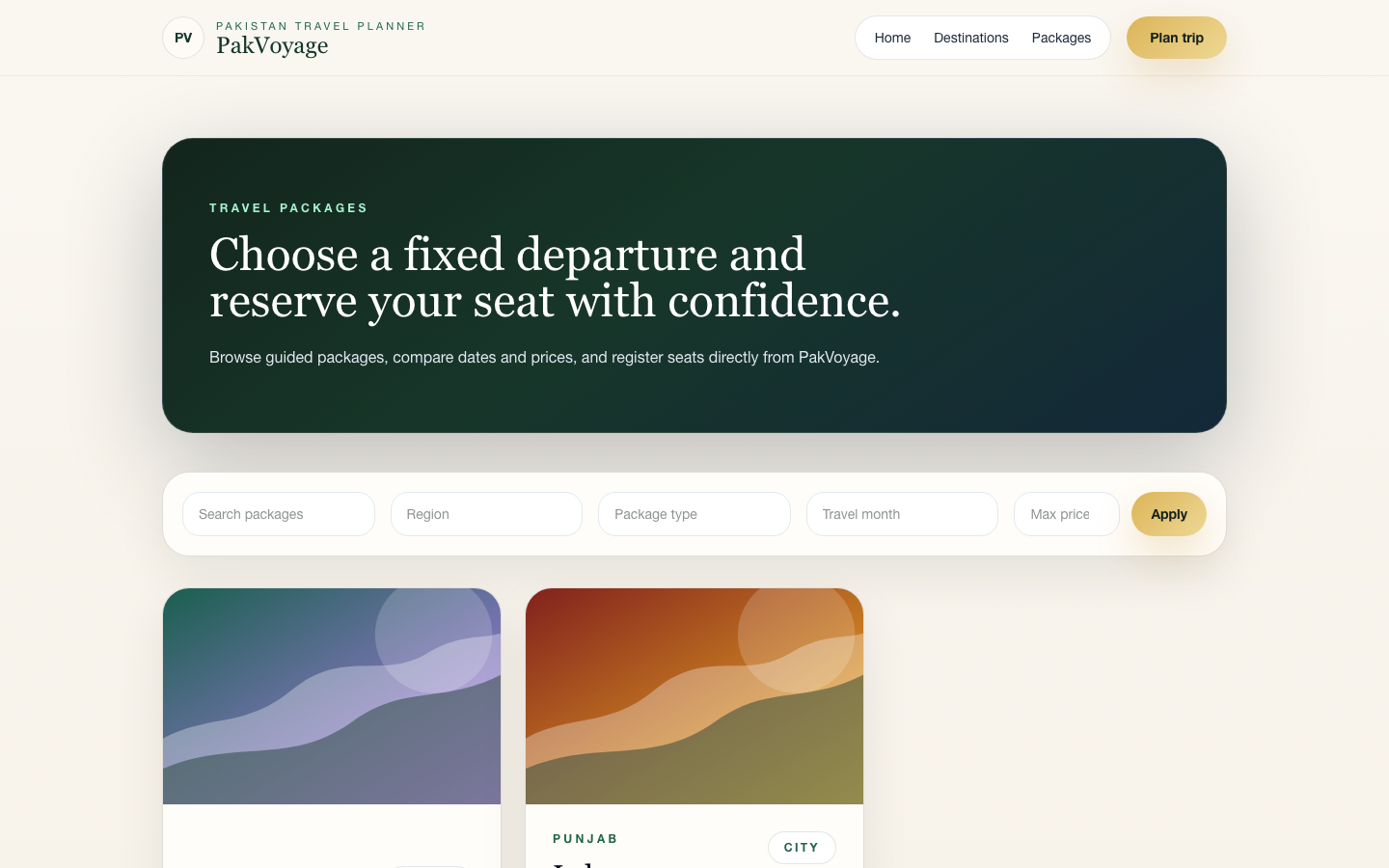
Curated tour packages with seat availability, package reservations, and custom-trip registration
Authenticated admin workflows for destinations, packages, media galleries, bookings, payment status, and customer requests
Engineering
Technical Signals
These signals show the implementation concerns that matter when a system moves beyond a prototype.
Engineering Signal
Itinerary engine selects destinations from traveler interests and distributes available days across the route
Engineering Signal
Centralized pricing service owns traveler-market rates, currency conversion, service fees, security costs, and display totals
Engineering Signal
Pricing snapshots preserve the market, currency, exchange rate, and calculated totals used at decision time
Engineering Signal
Seat reconciliation keeps package availability aligned when reservations are created or cancelled
Engineering Signal
Prisma relational models connect destinations, itineraries, itinerary days, packages, bookings, and custom-trip registrations
Engineering Signal
DTO validation, structured database-aware errors, file logging, and operational references improve API reliability and traceability
Workflow
How The System Moves
The strongest project pages explain what happens to state as users, admins, workers, and services interact.
- A traveler chooses a budget, trip duration, interests, traveler market, and display currency.
- The itinerary engine selects suitable destinations and distributes the trip days across the route.
- Activities and destination guidance are assembled into a day-by-day plan.
- The pricing service calculates regional rates, conversion, service fees, security costs, and an itemized total.
- The completed itinerary and pricing snapshot are persisted and can be shared.
- Travelers reserve package seats or submit custom-trip requests for admin review and status management.
Ownership
Role And Engineering Ownership
This section clarifies the engineering responsibility behind the system: architecture, implementation boundaries, delivery decisions, and maintainability.
Designed the domain model for destinations, itinerary days, packages, bookings, custom-trip registrations, and pricing snapshots.
Separated itinerary composition from pricing so traveler choices, market rates, exchange-rate snapshots, and operational records remain traceable.
Built the full-stack workflow foundation across public planning surfaces, API validation, and authenticated admin operations.
Evidence
Confirmed Evidence Signals
These signals describe concrete implementation evidence without exposing private source code, credentials, or employer-owned details.
Functional full-stack MVP with persisted itinerary and pricing records
Multi-currency pricing snapshots for local, Chinese, and international traveler markets
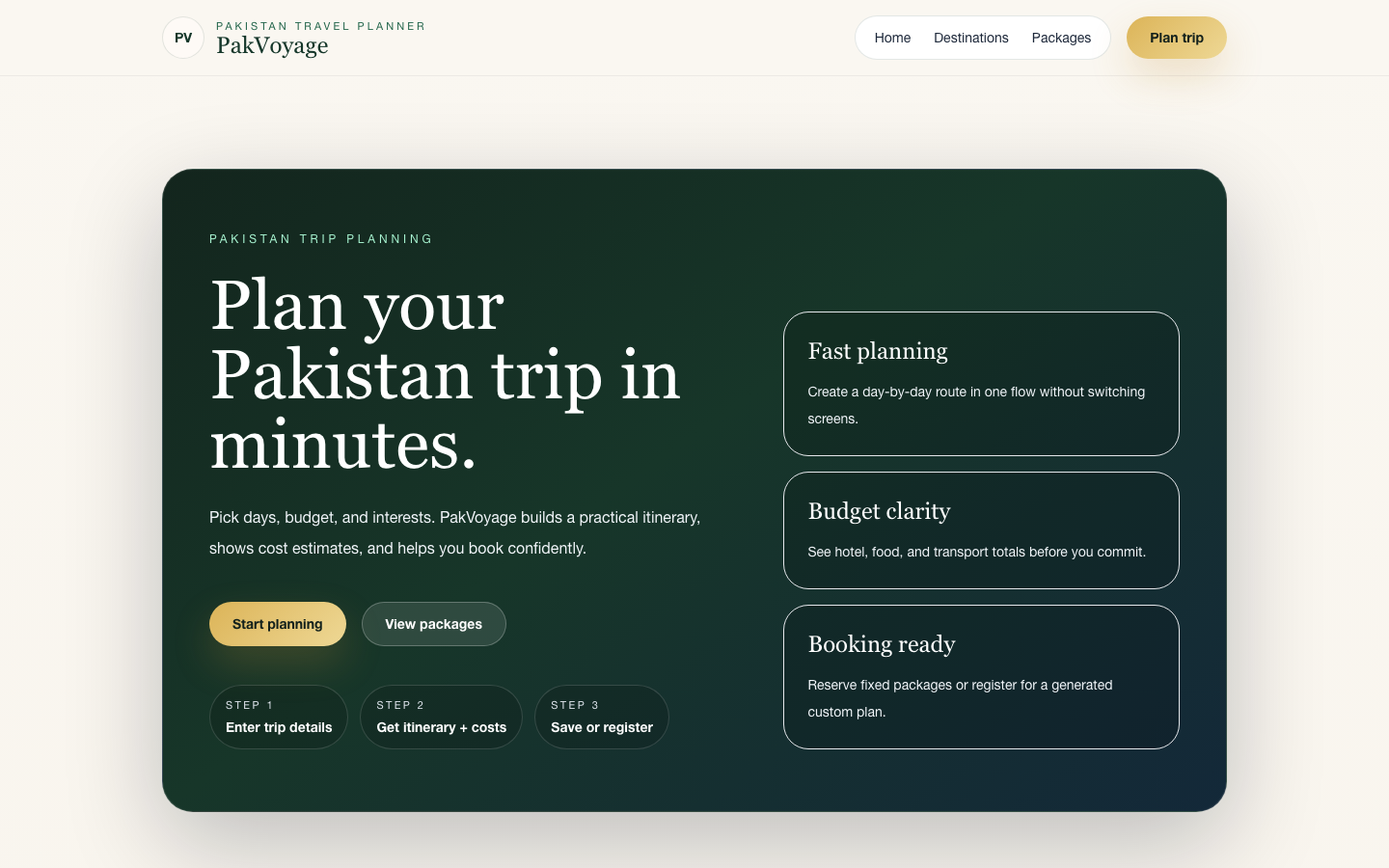
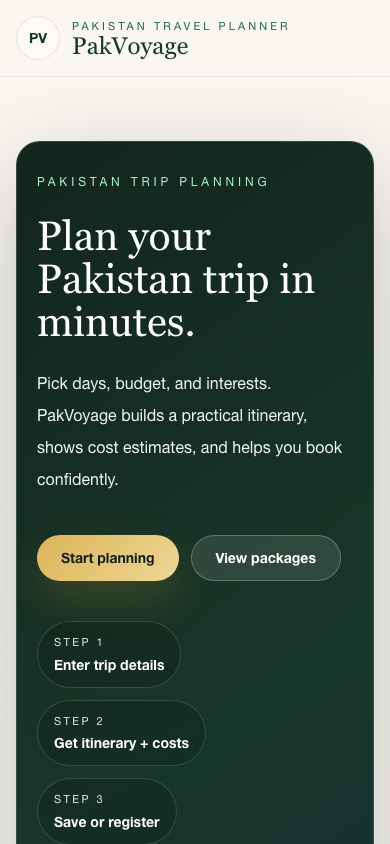
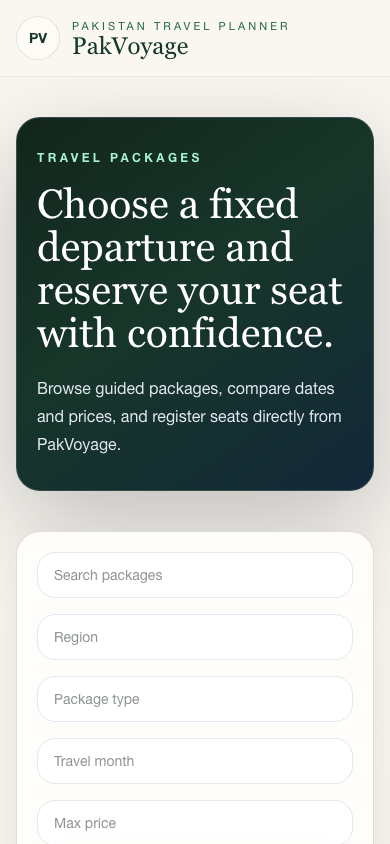
Screenshots available for landing, planner, and package discovery workflows across desktop and mobile
Constraints
Delivery Constraints
Constraints make the project easier to evaluate because they show the real boundaries that shaped architecture and trade-offs.
- Customer accounts, RBAC, payment integration, and production cloud image storage remain future expansion points.
- Pricing behavior had to preserve historical decisions even when exchange rates or service assumptions changed later.
Reflection
Engineering Lessons
Lessons capture the trade-offs and system-design judgment that matter beyond the implementation itself.
- Travel workflows need snapshot-based pricing because totals can become incorrect when rates or exchange assumptions change after a user decision.
- A planning product becomes easier to evolve when itinerary structure, destination data, and cost calculation are independent domains.
Screenshots
Project Interface
Portfolio-safe interface screenshots show the visible product workflows without exposing private client data, credentials, or source code.
Desktop
Mobile

Case Study
Architecture Breakdown
The architecture breakdown uses the same structure across projects: scope, problem, architecture, data flow, engineering decisions, scaling strategy, and outcome.
Functional MVP
View ProjectItinerary Orchestration & Cost Modeling Platform
Engineering Scope
Destination discovery, personalized multi-day itineraries, regional multi-currency pricing, package reservations, custom-trip registrations, and authenticated travel operations.
Problem Statement
Travel planning information for Pakistan is fragmented across destination websites and manual booking channels. The platform needed to unite research, itinerary creation, cost estimation, package discovery, and registration in one coherent experience.
Architecture Overview
Next.js 14, React, TypeScript, and Tailwind CSS power the responsive frontend. A modular NestJS REST API uses Prisma and PostgreSQL for destinations, itinerary days, packages, bookings, custom-trip registrations, and persistent pricing snapshots, with token-based authentication protecting admin operations.
Data Flow Explanation
Budget, duration, and traveler interests feed an itinerary engine that selects destinations and distributes days across the route. A centralized pricing service applies traveler-market rates, currency conversion, service fees, and security costs before persisting the itinerary and its pricing snapshot. Package and custom-trip submissions then enter admin-managed operational workflows.
Engineering Decisions
Itinerary composition, destination content, and pricing rules were separated into explicit domains. Price and exchange-rate inputs are snapshotted so historical totals remain operationally accurate, while booking creation and cancellation reconcile package seats. DTO validation, structured database-aware errors, and references such as PV-ITN-XXXXXX and PV-CTR-XXXXXX make workflows traceable.
Scale & Reliability Considerations
Relational models and a centralized pricing boundary support additional destinations, traveler markets, currencies, and fee rules without duplicating calculations across screens. The MVP currently uses admin authentication and local file-backed media workflows; customer accounts, RBAC, payment-gateway integration, and production cloud image storage remain future enhancements.
Outcome
Delivered a functional full-stack MVP that combines Pakistan destination discovery, shareable itinerary generation, multi-currency cost modeling, package reservations, custom-trip intake, and authenticated operational management.